
Ground Mats for Parking Lots: Temporary and Overflow Parking Surfaces
2026-08-19 · SIGMA 기술팀
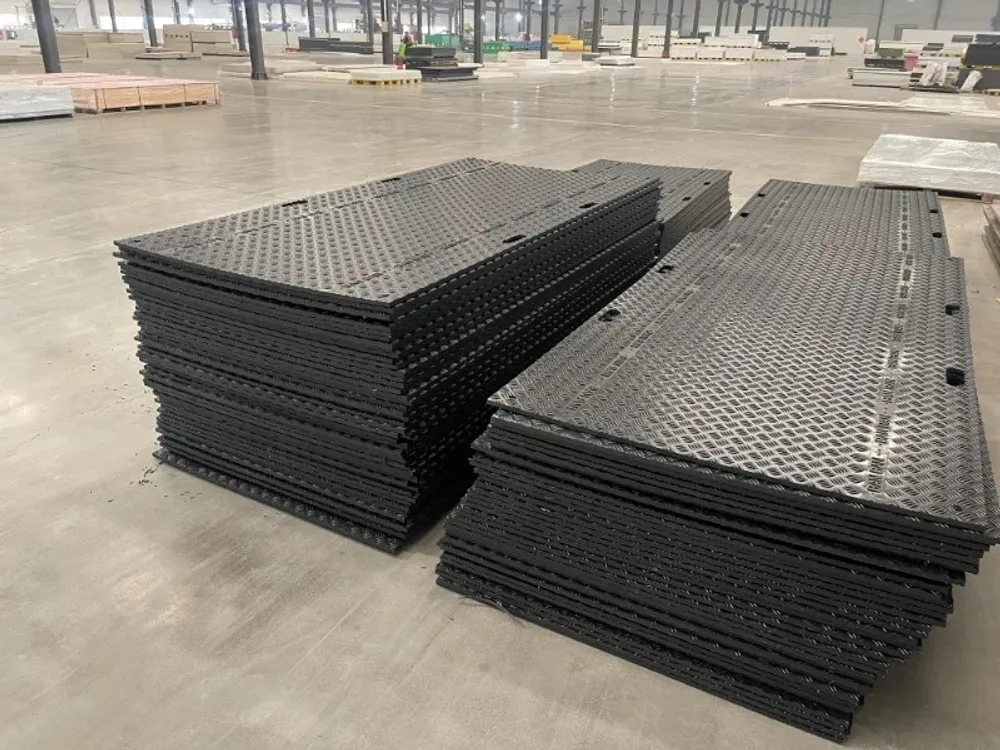
How HDPE ground mats turn grass, gravel, and made-up ground into working parking — when to use solid mats, when a grass grid is the better answer, and how to size for car and van traffic.
Parking is a load case, not a surface finish
A parking area fails for one of two reasons: the ground gives way under wheels, or the surface churns up and stops draining. Both come down to how the load spreads. A car sitting still spreads roughly 250–350 kg per wheel over a contact patch the size of a hand, and that is survivable on most firm ground — the damage comes from turning wheels on wet grass and from the same lane being driven a hundred times a day. Ground mats solve it by spreading each wheel load across a full panel and giving tyres a consistent surface to turn on, which is why the same mats used for site access also work for parking.
Temporary parking for events and construction
For an event car park, a site compound, or overflow parking at an open day, solid panels laid onto existing ground are the fastest option: there is no excavation, no sub-base, and the surface lifts out afterwards with the grass intact underneath. Panels link edge to edge into parking bays and access lanes, and the reversible tread gives grip in the wet. Because the mats are reusable, the cost per event drops sharply for anyone running the same layout more than once a season — the same logic covered in renting versus buying ground protection mats.
Reinforcing grass and gravel that stays in place
Where parking is permanent but should stay green or permeable, a grid is the better product. A turf reinforcement grid or gravel grid gets filled with soil and seed or with aggregate and locks the fill against rutting and migration, so the parking area drains and looks like lawn or gravel rather than plastic. That is a different job from a solid mat: grids are a sub-surface reinforcement you leave in place, mats are a removable surface you lay on top. Our guide to grass grid car parks covers the build-up in detail.
Sizing for cars, vans, and the occasional truck
For car and light-van parking, the standard 4×8 ft mat at around 12–13 mm handles the load comfortably on a competent sub-grade. Add delivery vans, a shuttle bus, or plant crossing the same lane and the access route — not the parking bays — is what needs the step up to a heavy-duty mat or a temporary roadway panel. The common mistake is specifying the whole area to the heaviest vehicle that will ever visit; it is cheaper and easier to handle if the entry lane carries the heavy section and the bays carry the standard one.
Laying out a parking area that works
Start with the traffic route rather than the bays: the entrance, the turning circle, and the lane every vehicle uses take the most passes and need the most attention. Keep runs continuous and pinned so panels cannot creep apart under turning wheels, and give any slope a run of mats rather than isolated pads so a wheel never sits half-on and half-off an edge. On soft ground, widen the lane instead of thickening the panel — spreading the same load over more area does more than adding millimetres. Get the layout right and a field or a gravel yard carries a full car park for a weekend and looks the same afterwards.
이런 프로젝트에 깔판이 필요하신가요? 견적 요청 — 영업일 기준 1일 이내에 답변드립니다. 또는 전체 제품 라인업.
견적 요청관련 기사
Logging Mats: A Buyer's Guide for Soft and Wet Ground
How logging mats hold up a haul road through soft or wet timber ground, how they differ from dragline mats, and how to size HDPE against the machines that will cross them.
자세히 보기 → Anti-Bogging Plates and Trackway: Getting Out, and Staying Out, of Soft Ground
Recovery boards and HDPE trackway solve two different soft-ground problems — one gets a stuck vehicle moving, the other stops it getting stuck. How they compare in mud, sand, and snow, and when to use each.
자세히 보기 → 공사 트랙아웃 제어 매트: 공공 도로에 진흙 묻히지 않기
HDPE 진입 매트가 현장 출구에서 트랙아웃 제어를 어떻게 뒷받침하는지 — 타이어를 안정된 표면 위에 두어 공공 도로에 닿는 진흙을 줄이며, FODS와 SWPPP 요건과 함께 작동합니다.
자세히 보기 →