
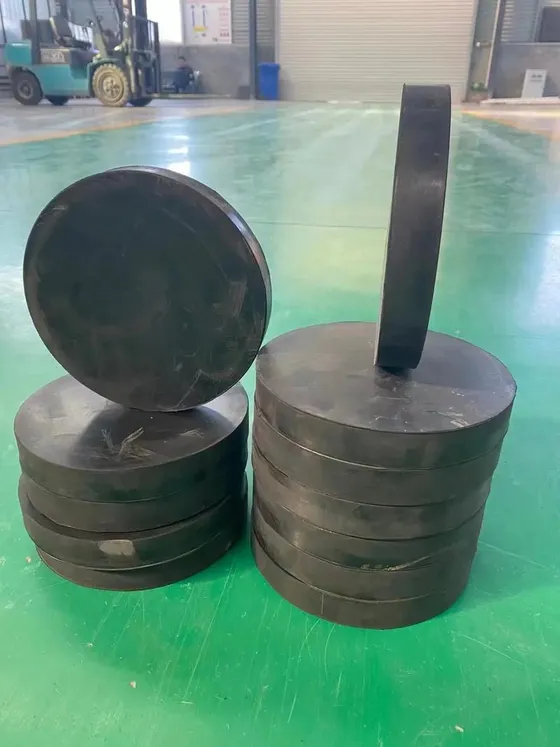
 Outrigger Pads
 Round Outrigger Pads
Round outrigger pads (outrigger mats) for MEWPs, boom lifts, bucket trucks, and smaller cranes.
- 300–1200 mm
- 3/4–2 in
- rolls
Products / Outrigger Pads
A square HDPE pad placed under crane and MEWP outrigger feet to spread point loads and stop the machine sinking. Lightweight, non-conductive, and chemical-resistant, with moulded hand-grips for one-person handling.
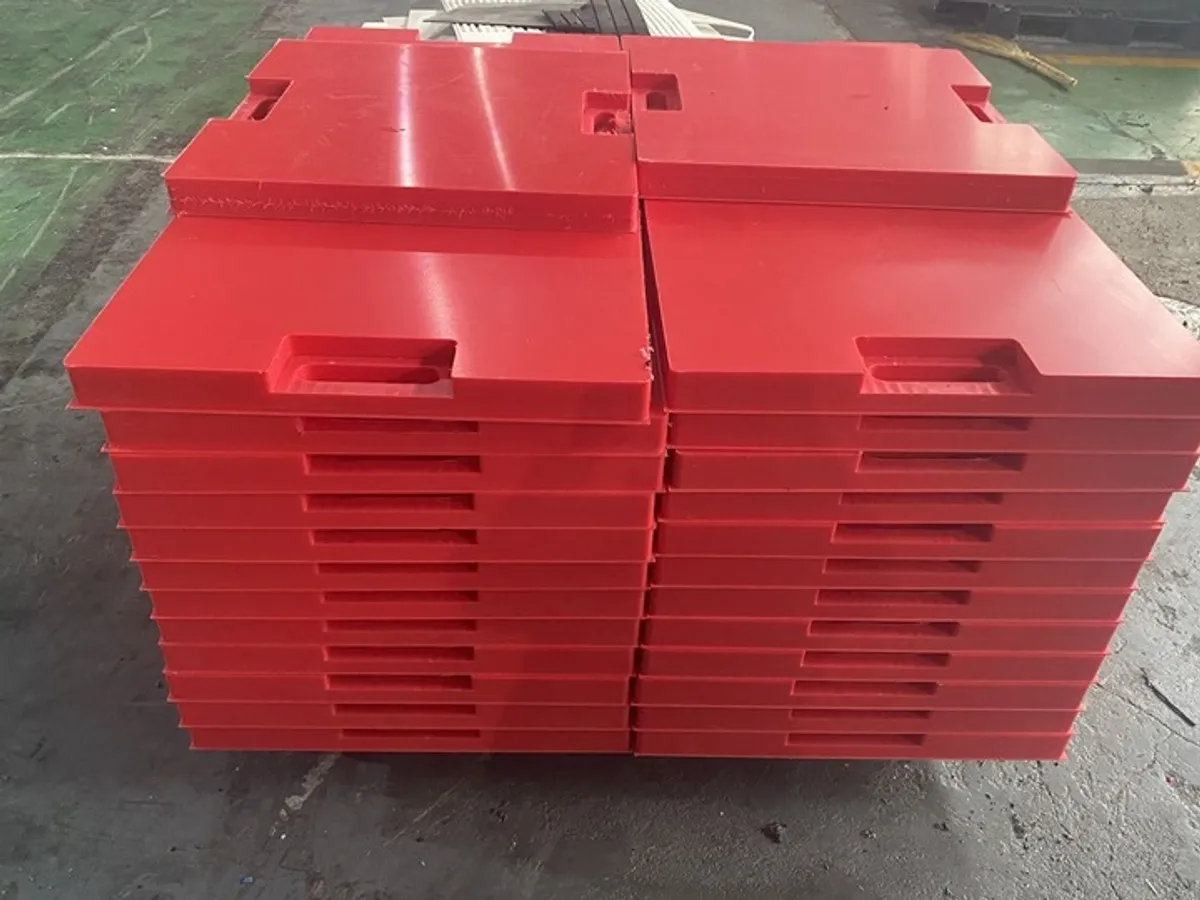
A crane concentrates its whole working weight onto four small outrigger floats. Put that float straight on the ground and the pressure often exceeds what the soil can hold, and the crane leg sinks — the leading cause of mobile-crane tip-overs. Crane outrigger pads — also called crane pads, crane support pads, crane leg pads, or crane foot pads — spread that point load over a larger area so the machine stays level and stable through the lift. The same problem shows up under crane outrigger feet on a boom truck or a concrete pump: an unsupported float finds soft ground fast.
The rule is simple: pad area = maximum outrigger load ÷ the ground’s safe bearing pressure. Weaker ground needs a bigger pad, not a thicker one. The same arithmetic sets the size of the smaller crane jack pads used under service trucks and lorry-mounted cranes. Square pads run 18×18 in up to 48×48 in (450–1200 mm) with a vertical working load limit from about 12 t to over 100 t by size, so you can match the pad to the leg load and the soil instead of guessing — the full method is in the crane outrigger pads sizing guide. We stock these crane pads for sale across the full size range, factory-direct.
The square form puts the most area under the float for a given dimension and gives a stable seat for spreader-beam feet and large float plates — sold by some as spreader pads or composite outrigger pads. Moulded in HDPE or UHMW at 1–4 in thick, these plastic crane pads replace the aluminium outrigger pads and timber packing crews used to stack, and cover everything from backhoe outrigger pads up to mobile crane outrigger pads for the largest crawler cranes; the pad spreads pressure without flexing apart, and a cut-in grip keeps it a one-person carry around the setup.
Mobile crane setup, concrete pump stabilisers, piling rig feet, and outrigger pads for boom truck work — anywhere outriggers land on anything softer than engineered hardstanding. The polymer is non-conductive and will not rot or soak up water, so the pads live on the truck between jobs. For cylindrical MEWP and boom-lift feet, the round outrigger pad seats more neatly.
Before crane pads existed as a category, crews packed the outrigger float with stacked timber or slid a plate of steel underneath, and plenty of yards still keep some of each. Set them side by side and the case for HDPE heavy duty outrigger pads is straightforward: timber absorbs water, swells, and rots after a season left on a truck bed, while steel plate does not rot but conducts electricity and corrodes at the welds — both routinely need two people or a hoist to move. A moulded HDPE pad in the same footprint is roughly half the weight of steel and does not take on water like timber, so it stays a one-person lift for the life of the pad.
| HDPE crane pad | Timber | Steel plate | |
|---|---|---|---|
| Weight, 24×24 in / 2 in | ~14–18 kg, one-person carry | ~25–35 kg, heavier once wet | ~35–45 kg, often needs a hoist |
| Water | Will not absorb, rot, or delaminate | Absorbs and swells; rots outdoors within a season or two | Will not absorb, but rusts and pits at welds |
| Conductivity | Non-conductive | Conducts once wet | Conducts — a hazard near live services |
| Service life | 10+ years, UV- and chemical-resistant | 2–4 years outdoors before replacement | Long-lived but corrodes at cut edges and welds |
| Handling | Moulded grip, one person | Splinters; often a two-person carry | Sharp edges; usually two people or a hoist |
The load-chart method above is the accurate way to size a pad for a specific lift, but as a starting point for outrigger pads for crane classes commonly on site, here is how the range typically breaks down. Treat it as a first cut, not a substitute for checking the actual outrigger load at your working radius.
| Crane class | Typical pad size | Thickness | Vertical WLL |
|---|---|---|---|
| ~25 t mobile crane / MEWP | 18×18–24×24 in (450–600 mm) | 1–2 in | ~12–25 t |
| ~50 t mobile crane | 24×24–30×30 in (600–750 mm) | 2 in | ~25–45 t |
| ~100 t mobile crane | 30×30–40×40 in (750–1000 mm) | 2–3 in | ~45–75 t |
| ~250 t crawler / large mobile crane | 40×40–48×48 in (1000–1200 mm) | 3–4 in | ~75–100+ t |
Pull the maximum outrigger load from the crane’s load chart at your worst-case working radius, then divide by the ground’s safe bearing pressure to get the pad area — that calculation, not the crane’s rated tonnage alone, is what sizes the pad correctly. As a working range, square crane outrigger pads span 18×18 in up to 48×48 in (450–1200 mm) with a vertical working load limit from about 12 t to over 100+ t by size, covering everything from a spider crane to a large crawler. If the ground is soft, wet, or unknown, round up to the next size rather than trust the low end of the range — an oversized outrigger mat costs little; a leg that settles mid-lift does not.
A pad that lives on the truck between jobs still needs a quick check before it goes under a loaded outrigger: look for cracks or gouges that cut into the load-bearing thickness, check the moulded grip has not torn away, and confirm the surface is free of mud or grease that could let the float skate sideways during setup. HDPE will not rot or corrode in storage, so pads stacked flat in a yard or racked upright in a truck body need no more than an occasional wipe-down — no oiling, no re-galvanising, none of the upkeep timber and steel demand. A pad that has taken a hard hit or shows a crack through more than a third of its thickness should be pulled from service rather than risked under a rated lift; the cost of a replacement pad is trivial next to the cost of a leg settling mid-pick.
Crane outrigger pads sit at the point where the machine meets the ground, often close to buried cable runs or under overhead lines, so the fact that HDPE does not conduct electricity is not just a durability feature — it is a safety one. Unlike steel plate, a polymer pad will not become a live path back through the outrigger float if insulation elsewhere on site fails, and unlike timber it does not become conductive once soaked by rain. That is one more reason plastic crane pads have largely replaced aluminium and timber packing on sites with live services nearby.
| Size | 18×18 to 48×48 in (450–1200 mm) |
|---|---|
| Thickness | 1–4 in (25–100 mm) |
| Vertical WLL | ~12–100+ t by size |
| Material | HDPE / UHMW |
| Color | Black |
| Handle | Cut-in grip |
Quoted load figures assume a competent, evenly prepared sub-grade. A mat spreads and distributes load — it does not turn soft ground into hard standing — so size to ground bearing pressure (load ÷ contact area).
Cranes use outrigger pads, catalogued by some suppliers as crane stabilizer pads, placed under each stabiliser foot to spread the point load and stop the leg sinking. These mats for cranes have to carry the working weight of the machine during a lift, not its parked weight. Square HDPE pads run 18×18 to 48×48 in (450–1200 mm) with a vertical working load limit from about 12 t to over 100 t by size. Pad area is sized by outrigger load ÷ ground bearing pressure, not guesswork.
Size by the maximum outrigger load from the crane’s load chart at worst-case radius, divided by the ground’s safe bearing pressure — weaker ground needs a bigger pad, not a thicker one. Square pads span 18×18 in up to 48×48 in and carry roughly 12 t to over 100 t vertical working load limit by size, so match the pad to the leg load and the soil.
Retire a pad once a crack runs through more than about a third of its thickness, the moulded grip has torn away, or an impact has visibly deformed the surface. HDPE does not rot or corrode in storage, so a pad that looks sound and has no structural damage keeps its rated working load limit for years — inspection before each rated lift is what confirms it, not age alone.
Tell us quantity, destination port, and any questions — we reply within one business day.
Outrigger Pads Round outrigger pads (outrigger mats) for MEWPs, boom lifts, bucket trucks, and smaller cranes.
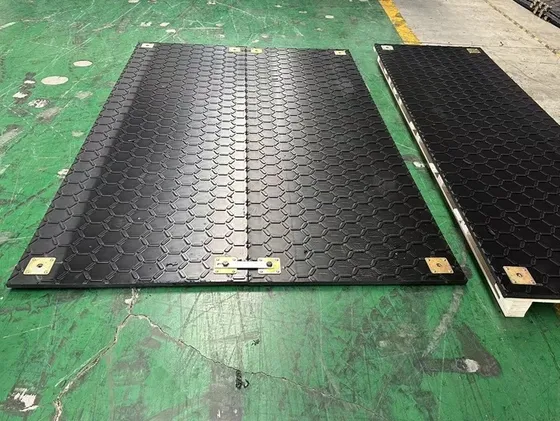 Ground Protection
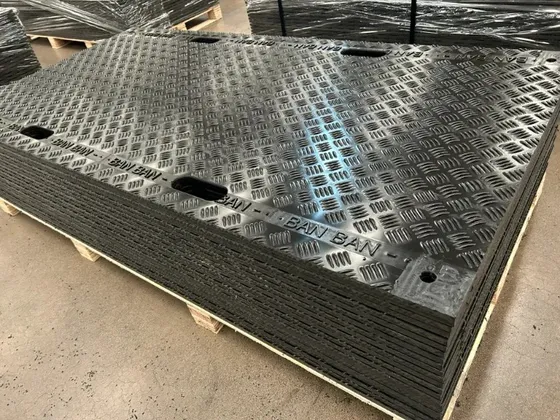
 The everyday 4x8 ground protection mat — black HDPE / plastic ground protection sheets, reversible tread, hand-portable, reusable for years.
 Heavy-Duty
 Thicker, denser 4×8 ft heavy-duty ground protection mat for loaded trucks, dozers, and excavators.