
Temporary Access Across Coastal Wetland for a Utility Crew
2026-04-02 · Utilities · Southeast Asia
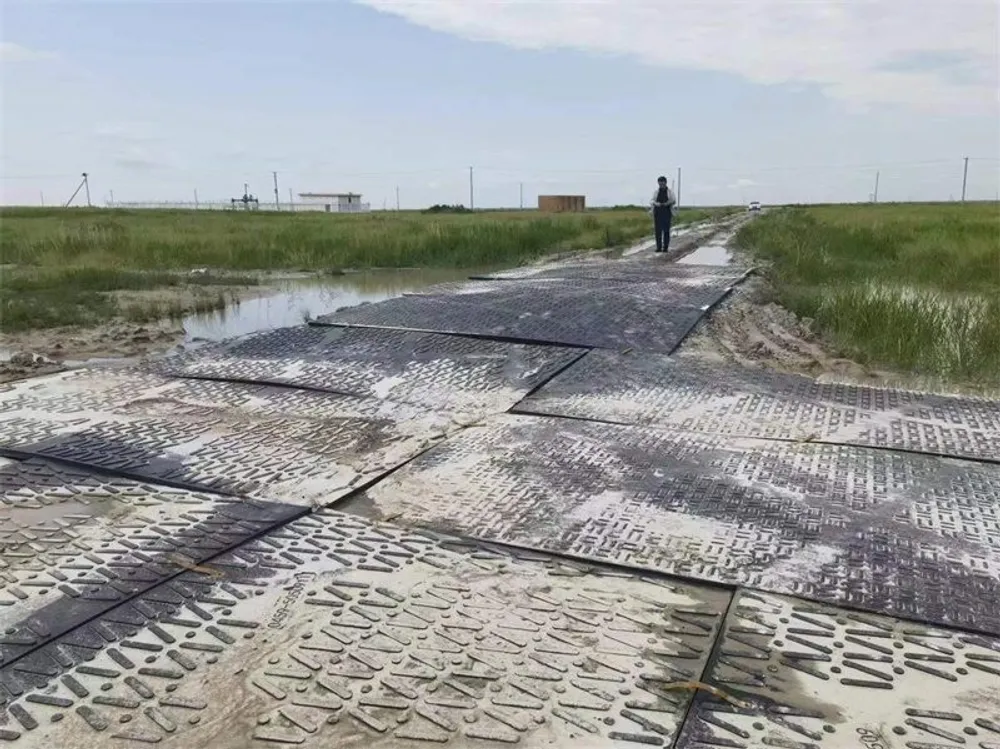
A panel roadway let a utility contractor cross waterlogged coastal wetland to reach pipeline tie-in points without building a permanent embankment.
The ground
A utility contractor in Southeast Asia needed to reach several pipeline tie-in points roughly 400 metres from the nearest hard road, across coastal wetland with standing water, saturated peat, and dense reed grass. There was no existing track, the area floods seasonally, and permanent fill embankments were neither practical nor welcome on ground this sensitive. The nearest point a truck could park and unload was the hard road itself, so every panel had to be carried in by hand or dragged across the mats already down.
The challenge
Trucks and a mini excavator needed to reach the tie-in points repeatedly over several weeks as each connection was completed in turn. Without a load-spreading surface, both would sink into the peat within the first pass, and building a gravel haul road would have meant a longer permitting process, higher cost, and ground disturbance that would outlast the project itself.
Two mat types for two ground conditions
The route was not uniformly wet. Drier ground nearer the road could carry the lighter temporary roadway panel, while the standing-water stretch in the middle needed the wider footprint and higher flotation of the bog mat to keep the excavator from sinking. Splitting the route between the two kept the total tonnage of matting on site — and the freight to get it there — lower than laying bog mat the full 400 metres.
The panel road
The crew laid the panels end to end across the marsh, using the connectors to keep the run from separating as the saturated ground flexed underfoot. Rather than displacing the wet peat, the mats floated the load across it, and the whole run could be lifted and moved to the next section as the pipeline work progressed.
Result
The finished route covered around 1,300 m² — roughly 400 metres by 3 metres — and a four-person crew laid it in two days by hand, working out from the road toward the tie-in points as each section was placed. It carried the excavator and material trucks through the full tie-in programme without a single vehicle getting stuck. Once the work was done, the mats were pulled up, the wetland was left at its original grade with no embankment or fill to remove, and the same panels were trucked to a separate wetland crossing further along the pipeline route for the next stage of the job.
Want details or a quote? Contact us — we reply within one business day. Or browse the product range.
Request a QuoteRelated case studies
2026-08-01
Bulk Container Order for an Overseas Rental Fleet
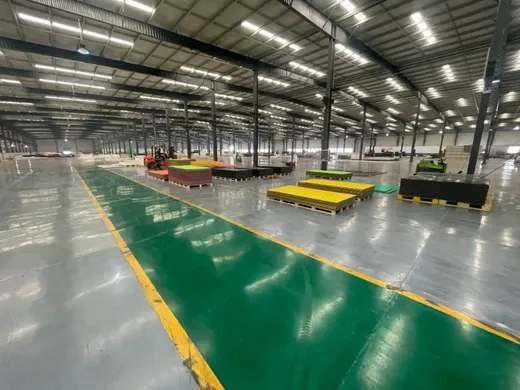
A container-scale order of heavy-duty and standard mats moved from press mould to loaded pallet in weeks, ready to stock an overseas rental fleet ahead of its build season.
Read →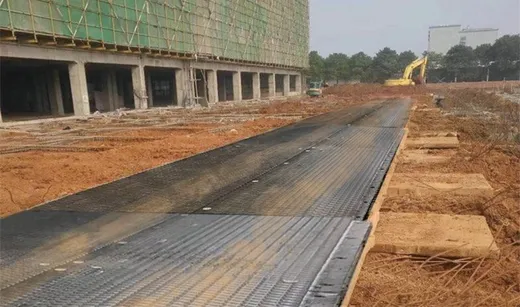
2026-07-05
A Temporary Site Road for Concrete and Material Trucks
Ground protection mats gave a mid-rise building site a stable haul road from the gate to the pour, keeping concrete mixer trucks moving through a wet spring.
Read →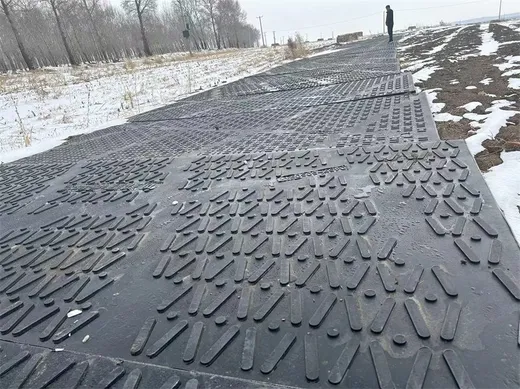
2026-06-10
A Winter Haul Road Across Frozen Farmland
Heavy-duty mats carried loaded delivery trucks across a freeze-thaw farm route, protecting topsoil and keeping pipe deliveries on schedule through a winter build window.
Read →